Here’s a number that stops people cold: $400. That’s roughly what it takes to cover a surprise car repair or emergency vet bill, and a huge chunk of working Weekly Savings Challenge for a Small Budget That Works adults couldn’t pull it together without borrowing or selling something. If that sounds familiar, a weekly savings challenge for a small budget isn’t just a nice idea — it’s one of the few savings methods that actually works when your paycheck is already stretched thin.
Most savings advice assumes you’ve got wiggle room. Cut the coffee, skip a few takeout orders, boom, $200 a month appears. But if you’re living paycheck to paycheck, that wiggle room doesn’t exist. A weekly savings challenge for a small budget flips the approach — instead of finding one big chunk of money, you’re building a habit out of small, repeatable amounts that don’t wreck your week.
Why a Weekly Format Beats Monthly Goals
Monthly savings goals sound good on paper. In practice, they’re easy to blow off in week one and impossible to recover from by week four. A weekly rhythm is shorter, so mistakes don’t compound, and the finish line is always close enough to feel real.
There’s also a psychological trick here that’s worth naming. Weekly check-ins force you to notice your spending patterns in near real-time, not thirty days later when the damage is already done. You catch the problem while it’s still a $12 mistake, not a $200 one.
How the Weekly Savings Challenge for a Small Budget Actually Works
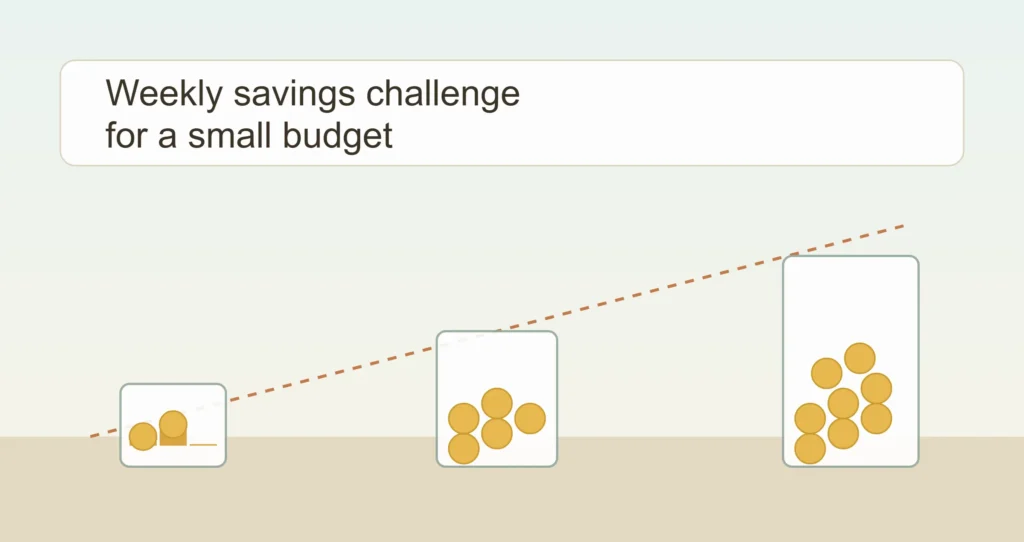
The classic version of this challenge has you save an increasing amount each week — week 1 you save $1, week 2 you save $2, and so on. By week 52, you’ve saved $1,378. It’s a nice structure, but for a lot of people on tight budgets, the final months get brutal when you’re setting aside $45 or $50 a week.
A more forgiving version works better for small or irregular incomes:
- Pick a flat weekly amount you can realistically hit every single week, even a bad one — $5, $10, or $15.
- Add a “found money” bonus round whenever extra cash shows up (a refund, a gift, overtime pay).
- Reassess every four weeks instead of committing to 52 weeks of rigid numbers upfront.
This isn’t about hitting an impressive total by December. It’s about proving to yourself that saving is possible on your actual income, not some hypothetical one.
A Quick Example
Say you commit to $8 a week. That’s roughly the cost of a lunch out, but spread across seven days it barely registers. After a year, you’ve got $416 sitting in savings — enough to dodge that surprise car repair without reaching for a credit card. Small, boring, and it works.
Where Irregular Income Changes the Math
If your paychecks don’t come in the same size every time — freelance work, gig driving, tips, seasonal jobs — a rigid weekly number can set you up to fail. This is where learning how to make a monthly budget with irregular income actually pairs well with a weekly savings habit.
The basic idea: instead of budgeting off your best month, budget off your worst realistic month. Here’s the general order of operations:
- Look back at the last 6-12 months of income and find your lowest month.
- Build your essential expenses (rent, utilities, groceries, debt minimums) around that number.
- Treat anything earned above that baseline as “bonus” income for savings or catch-up spending.
- Assign that bonus income to your weekly savings challenge in whatever amount fits that week — some weeks $20, some weeks $2.
This gives you a savings system that bends with your income instead of breaking against it. On slow weeks, you save the minimum. On strong weeks, you push harder. Either way, you’re still in the challenge, which matters more than any single week’s total.
Common Advice I’d Push Back On
A lot of savings content tells you to automate everything and “pay yourself first” no matter what. For steady salaried income, that’s solid advice. For a genuinely small or unpredictable budget, automating a fixed amount can backfire — you overdraft, get hit with a fee, and end up worse off than if you’d just saved manually that week.
If your income swings, a semi-manual system where you actively choose your weekly amount usually beats a rigid autopilot transfer. You can always automate later once your income stabilizes and you’ve built a buffer.
Tools That Make It Easier to Stick With
You don’t need a fancy app for this, but a few things help:
- A separate savings account so the money isn’t sitting next to your spending cash, tempting you.
- A visual tracker — a printable chart, a spreadsheet, or a jar with 52 marked slots — so you can see progress physically.
- A recurring weekly reminder, even a basic phone alarm, so the challenge doesn’t quietly fade out by March.
If you’re also working on a debt-repayment plan, a solid budget makes both easier to manage at the same time — the two goals aren’t in competition the way they sometimes feel.
Making It Stick Past Week One
The real test of any weekly savings challenge for a small budget isn’t the first month — it’s whether you’re still doing it in month six. Give yourself permission to skip or lower a week without quitting the whole thing. One missed week doesn’t erase the progress you’ve already made, and restarting is always cheaper than never starting.
This article is for informational purposes only and does not constitute financial, investment, or legal advice.
Read This
How to Save Money on a Low Income (Without Misery)
FAQS
Is a weekly savings challenge actually effective for people living paycheck to paycheck?
Yes, especially when the amounts are flexible rather than fixed. The habit of setting money aside weekly, even small amounts, tends to matter more long-term than the specific dollar figure.
How much should I save each week if my income is inconsistent?
Base it on your lowest-earning weeks, not your best ones. A flexible range (like $2-$20) tends to work better than a fixed number when income varies.
What’s the difference between a weekly savings challenge and just budgeting normally?
Regular budgeting tracks all your spending across the month. A weekly savings challenge is a narrower, standalone habit focused specifically on setting aside a small amount every week, which makes it easier to start even if the rest of your budget feels messy.