Let’s say your paycheck lands and it’s $3,000 for the month. Rent’s due Friday, your car needs an oil change, and somehow you still want money left over for a night out 50/30/20 Budget Rule Example for a $3000 Salary. Sound familiar?
That’s exactly the gap the 50/30/20 budget rule was built to close. It’s not a fancy system, and it’s not going to ask you to track every receipt for the rest of your life. It just gives your money three jobs: needs, wants, and savings. If you’ve been Googling a 50/30/20 budget rule example for a $3000 salary because you want actual numbers instead of vague percentages, you’re in the right place.
What the 50/30/20 Budget Rule Actually Means
The math behind the 50/30/20 budget rule is simple on paper. You split your take-home pay into three buckets:
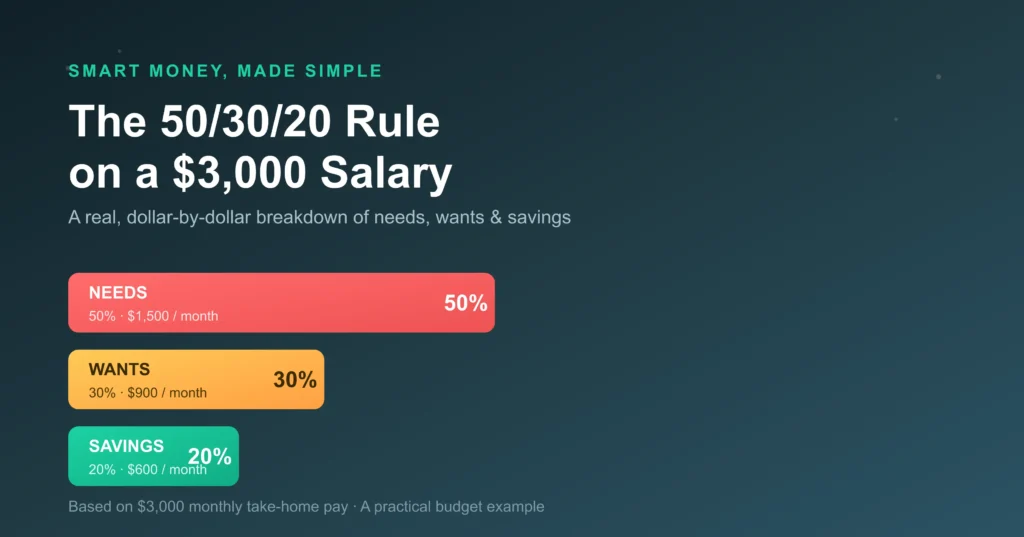
- 50% goes to needs (housing, groceries, utilities, minimum debt payments, transportation)
- 30% goes to wants (dining out, hobbies, subscriptions, that one shoe habit)
- 20% goes to savings and extra debt payoff
For a $3,000 monthly income, that breaks down to $1,500 for needs, $900 for wants, and $600 for savings. Clean, round numbers — which is exactly why this budget rule example works so well when you’re first learning to budget.
A lot of people assume this split has to be exact down to the dollar, but here’s what actually happens in real life: some months your needs creep to 55% because your electric bill spiked in July, and your wants shrink to 25% to cover it. That’s not failure. That’s just budgeting with a pulse instead of a spreadsheet.
50/30/20 Budget Rule Example for a $3000 Salary, Broken Down
Here’s what this could look like month to month, using $3,000 as take-home pay.
- Needs ($1,500) — rent or mortgage, groceries, electric and water bills, phone plan, gas, insurance, minimum payments on any loans
- Wants ($900) — restaurants, streaming services, a gym membership, weekend plans, that new pair of sneakers
- Savings and debt payoff ($600) — emergency fund contributions, extra payments toward a credit card balance, retirement contributions, or a sinking fund for something like a car repair
If your rent alone eats $1,200 of that $1,500 needs bucket, you’ve only got $300 left for groceries, gas, and utilities combined — which for a lot of cities is genuinely tight. That’s usually the first sign this particular budget rule example needs a personal tweak, not that you’re bad with money.
Where People Get Stuck With This Budget Rule
Here’s my gentle pushback on the popular version of this advice: the 50/30/20 rule assumes your needs will always fit into half your income, and honestly, in a lot of markets right now, they just won’t. If your rent is already 40% of a $3,000 salary on its own, you don’t have room left for groceries and gas, let alone a want or two.
So instead of forcing the exact percentages, use them as a starting compass. If your needs run closer to 60% some months, pull the wants bucket down to 20% instead of pretending the math still works. The goal isn’t the percentages — it’s making sure something is always going toward savings, even if it’s $150 instead of $600.
How to Make a Monthly Budget With Irregular Income
If your $3,000 isn’t guaranteed every month — say you’re freelance, tipped, or on commission — this budget rule example still works, but you’ll want to build it around your lowest expected month rather than your best one.
Here’s a practical way to handle how to make a monthly budget with irregular income:
- Base your needs and wants percentages on your lowest realistic monthly income, not your average
- Any month you earn above that baseline, send the extra straight into savings or debt payoff
- Keep a small buffer fund (even $500) specifically to smooth out the gaps between good and slow months
This approach takes the guesswork out of budgeting with irregular income because you’re never assuming a good month will happen — you’re just taking advantage of it when it does.
Adjusting the 50/30/20 Rule to Fit Your Real Life
The 50/30/20 budget rule example for a $3000 salary above is a template, not a mandate. A few common tweaks:
- If you’re aggressively paying off debt, try 50/20/30 instead, shifting more toward payoff
- If your rent is unusually high for your area, some financial writers suggest a 60/20/20 split until your income grows or your rent situation changes
- If you’re saving for something specific, like a wedding or a move, you can temporarily shrink wants to boost that goal
None of these variations mean you’re doing the rule “wrong.” A budget rule example is only useful if it flexes with your actual bills, and if you’re also tackling debt, having this kind of structure in place makes that payoff plan a lot easier to stick to.
This article is for informational purposes only and does not constitute financial, investment, or legal advice.
Read This
How to Make a Monthly Budget With Irregular Income
FAQS
Is the 50/30/20 rule good for a $3000 salary?
Yes, especially as a starting framework — $1,500 for needs, $900 for wants, and $600 for savings gives you clear, round targets to work from before adjusting to your actual bills.
What if my rent is more than 50% of my income?
Then your needs bucket needs to expand beyond 50%, at least temporarily. Pull the difference from your wants category rather than skipping savings entirely.
How do I budget with the 50/30/20 rule if my income changes every month?
Base your percentages on your lowest expected income for the month, then route any extra earnings straight into your savings bucket once you hit that baseline.