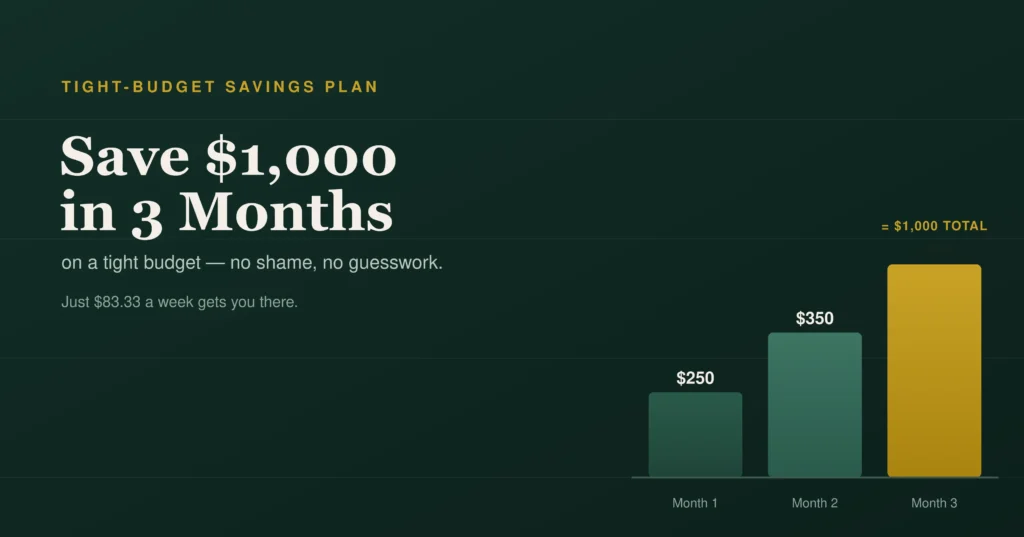
Here’s a number that stops most people cold: $83.33. That’s all you need to set aside each week to hit $1,000 in three months How to Save $1000 in 3 Months on a Tight Budge. Suddenly a goal that sounded impossible starts to look like something you could actually pull off, even on a paycheck that already feels stretched thin.
If you’ve Googled how to save $1000 in 3 months on a tight budget, you’ve probably already tried the usual advice — cut your coffee, skip a few dinners out, “just save more.” That stuff isn’t wrong, exactly. It’s just incomplete. Real savings on a real budget takes a little more structure than a motivational quote taped to your fridge.
I’ve worked with clients living paycheck to paycheck, gig workers with income that swings by hundreds of dollars a month, and dual-income households who still couldn’t explain where their money went. The plan below is built from what actually worked for them, not a theoretical spreadsheet exercise.
Why $1000 in 3 Months Is the Right Target
A thousand dollars isn’t a random number. It’s roughly what most emergency-fund experts recommend as a starter cushion — enough to cover a car repair, a broken appliance, or a surprise medical bill without reaching for a credit card.
Three months is also the sweet spot. Long enough that the plan doesn’t feel like a punishing sprint, short enough that you stay motivated and can actually see the finish line. When people try to save $1000 in 3 months on a tight budget without a deadline, momentum usually fizzles out by week four.
Step 1: Know Your Real Number Before You Cut Anything
A lot of people assume the fastest way to save $1000 in 3 months on a tight budget is to slash every non-essential expense immediately. But here’s what actually happens: they cut too hard, burn out in two weeks, and quietly go back to old habits — usually with some guilt attached.
Instead, start with a real audit:
- Pull the last two months of bank and card statements
- Highlight every recurring charge, subscription, and “small” purchase
- Add up total spending in categories like food, transportation, and entertainment
This takes maybe 45 minutes and it’s the single most useful thing you can do before making any changes at all.
If Your Income Is Irregular
If you’re a freelancer, work seasonal shifts, or have commission-based pay, a standard monthly budget with irregular income doesn’t map neatly onto a fixed savings plan. In that case, base your budget on your lowest-earning month from the past six, not your average. Anything above that baseline in a good month goes straight to savings — no negotiating with yourself later.
Step 2: Break the Goal Into Small, Boring Chunks
Trying to save $1000 in 3 months on a tight budget feels overwhelming as one big number. Broken down, it’s much less intimidating:
- Week 1-4: Save $250 (roughly $62/week)
- Week 5-8: Save $350 (roughly $87/week)
- Week 9-12: Save $400 (roughly $100/week)
Notice the amounts increase slightly over time. That’s intentional — the first month is usually the hardest because you’re still building the habit and identifying where your money leaks are.
Step 3: Find the Money Without Making Life Miserable
Here’s my one piece of gentle pushback against popular advice: you don’t need to eliminate every small joy to save $1000 in 3 months on a tight budget. Cutting your one weekly treat entirely often backfires — it creates a sense of deprivation that leads to bigger splurges later. Trimming it in half usually works better and lasts longer.
Look instead for the bigger, boring leaks:
- Subscriptions you forgot you had (the average household has at least one)
- Bank fees that add up to $10-$35 a month for basically nothing
- Grocery spending that creeps up because of convenience purchases, not need
Fixing these three areas alone often frees up $150-$250 a month without you noticing much difference in daily life.
Step 4: Automate It So Willpower Isn’t the Plan
Willpower is unreliable. Systems aren’t. Set up an automatic transfer to a separate savings account the day after each paycheck lands — before you see the money in your checking account and before it has a chance to get spent on something else.
If you’re following a monthly budget with irregular income, automate a percentage instead of a fixed dollar amount. Something like 10-15% of each deposit works well and scales naturally with whatever you bring in that month.
Step 5: Add Small Income Boosts Without Overcomplicating Things
You don’t need a side hustle empire to save $1000 in 3 months on a tight budget. A few hours a week of something simple — reselling unused items, picking up an extra weekend shift, or a small freelance gig in a skill you already have — can add $50-$150 a month without taking over your life.
Combine that with expense trimming and the math starts working in your favor much faster than cutting alone.
A Quick Note Before You Start
This article is for informational purposes only and does not constitute financial, investment, or legal advice. Everyone’s situation is different, and it’s worth adjusting these numbers to fit your actual expenses and income.
And if you’re also working on paying down debt, having a solid budget in place first makes that process a lot more manageable — the two goals tend to reinforce each other rather than compete.
Pick one step from this plan and start it this week — not next month, not “when things settle down.” The version of you three months from now with $1,000 in the bank started exactly where you are right now.
Read This
52 Week Money Saving Challenge Printable (That Actually Works)
FAQS
Is it realistic to save $1000 in 3 months on a tight budget?
Yes, for most households earning a regular paycheck. It requires roughly $83 a week, which is achievable through a combination of trimming a few recurring costs and automating savings, without needing a large lump sum upfront.
What if my income changes every month?
Base your plan on a monthly budget with irregular income by using your lowest-earning month as your baseline, then save a percentage of anything above that in stronger months.
What’s the fastest way to find extra money in my budget?
Start with subscriptions, bank fees, and grocery convenience spending. These three areas typically hide the most “invisible” money without requiring major lifestyle changes.