Picture two people, each carrying $14,000 in debt across four cards Debt Snowball vs Avalanche. One pays it off in four years and quits halfway through twice. The other pays it off in three years and eight months without ever wanting to quit. Same debt, same income, wildly different experience. That’s the real debate hiding inside the question “debt snowball vs avalanche which is better” — it’s not really about math, it’s about which version of you actually finishes.
If you’ve spent any time searching debt snowball vs avalanche which is better, you’ve probably already seen the basic definitions. So let’s skip the fluff and get into what actually separates these two methods, where each one falls apart, and how to figure out which one fits your specific situation instead of some generic “personal finance guru” archetype.
What Debt Snowball vs Avalanche Actually Means
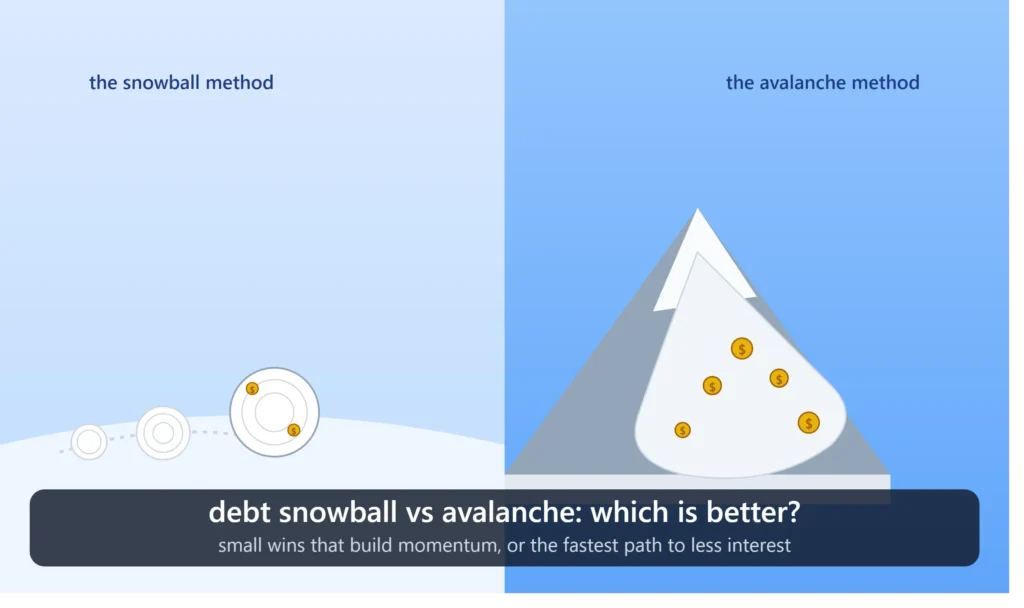
The debt snowball method has you list your debts from smallest balance to largest, ignoring interest rates completely. You throw every extra dollar at the smallest balance while paying minimums on everything else. Once that one’s gone, you roll its payment into the next smallest. It’s momentum by design.
The debt avalanche method sorts your debts by interest rate instead, highest to lowest. You attack the highest-rate debt first, regardless of how big or small the balance is. Mathematically, this saves you the most money over time because you’re cutting off the most expensive interest first.
Here’s the quick version if you just want the mechanics:
- Snowball: smallest balance first, ignore interest rate, build momentum through quick wins
- Avalanche: highest interest rate first, ignore balance size, minimize total interest paid
- Both: pay minimums on every other debt while you focus extra payments on the target debt
The Math Behind Debt Snowball vs Avalanche Which Is Better
Let’s use real numbers instead of vague percentages. Say you’ve got three debts: a $1,200 store card at 26% APR, a $6,500 credit card at 22% APR, and a $9,800 personal loan at 11% APR. You’ve got $400 a month extra to throw at debt beyond minimums.
Under avalanche, you’d hit the store card first since it has the highest rate, even though it’s also the smallest balance here — a lucky overlap. But flip the numbers slightly (say the personal loan carries the highest rate), and avalanche would have you grinding on a $9,800 balance for over a year before you see a debt disappear completely.
Under snowball, you always start with the $1,200 card no matter what its rate is. You’d likely clear it in three months, then feel that first “one down” moment. That psychological win is the whole point of the method.
Depending on your rates and balances, avalanche typically saves anywhere from a few hundred to a couple thousand dollars in interest over the life of your payoff plan. It’s rarely a massive difference unless your rate spread is huge — think a 6% loan next to a 29% store card.
Why the Math Isn’t the Whole Story
Here’s my pushback on the popular advice, because I think it oversells the interest savings angle. Most articles treat debt avalanche like it’s the objectively “smarter” choice and snowball like it’s a consolation prize for people who can’t do math. That’s backwards.
A lot of people assume the cheapest path is automatically the best path, but here’s what actually happens: if you pick the method that bores you or discourages you, you stop. I’ve watched clients abandon avalanche around month seven because they were still staring at a five-figure balance with nothing to show for it emotionally, even though they were saving money on paper. A half-finished avalanche plan costs way more than a completed snowball plan.
Who Should Use the Debt Snowball Method
The snowball method tends to work best if:
- You’ve tried paying off debt before and lost motivation partway through
- You have several smaller debts mixed in with larger ones
- You need visible proof you’re making progress to keep going
- Your interest rates are relatively close together, so the math difference is small anyway
If your biggest struggle has been consistency rather than math skills, snowball is usually the better call. The whole method is built around behavioral psychology, not spreadsheets.
Who Should Use the Debt Avalanche Method
Avalanche makes more sense if:
- You’re naturally motivated by numbers and don’t need quick emotional wins to stay on track
- Your interest rates vary a lot — like a 7% auto loan sitting next to a 27% credit card
- You’ve already got some experience successfully sticking to financial plans
- You want to minimize total interest paid above all else, even if progress feels slower at first
If you’re the type of person who tracks every dollar and gets a genuine kick out of watching an amortization schedule shrink, avalanche will suit your temperament fine, and it’ll save you real money doing it.
A Hybrid Approach Worth Considering
You don’t actually have to pick a permanent side in the debt snowball vs avalanche debate. Plenty of people start with snowball to build momentum on a smaller debt or two, then switch to avalanche once they’ve proven to themselves they can stick with a payoff plan. Others knock out one particularly high-interest debt first for the savings, then switch to snowball ordering for the rest to stay motivated.
There’s no rule that says you have to follow either method with religious precision. The goal is progress, not purity.
Making Either Method Work With Your Budget
Neither method works without a budget that actually reflects your real spending, and this gets tricky for anyone whose paycheck isn’t the same every month. If you’re also figuring out how to make a monthly budget with irregular income, that piece matters just as much as which debt payoff order you choose — a solid, flexible budget is what generates the extra payment money in the first place, whichever method you pick.
A few practical steps that help regardless of method:
- List every debt with balance, minimum payment, and interest rate in one place
- Decide on snowball, avalanche, or a hybrid based on what you know about your own follow-through
- Automate minimum payments so nothing gets missed while you focus on the target debt
- Recalculate your extra payment amount every time your income shifts, especially with irregular income
- Celebrate every payoff, even small ones — the emotional wins are part of the strategy, not a distraction from it
This article is for informational purposes only and does not constitute financial, investment, or legal advice. Everyone’s debt situation, income, and risk tolerance are different, so treat this as a starting framework rather than a rulebook.
Debt Snowball vs Avalanche Which Is Better: The Honest Answer
If you want the single clearest answer to debt snowball vs avalanche which is better, it’s this: the best method is the one you’ll actually stick with for the next 12 to 36 months. Avalanche wins on pure math. Snowball wins on follow-through. Since a debt payoff plan you abandon saves you zero dollars, follow-through usually wins in real life.
If you’re ready to pick a lane, grab your last three statements tonight, write down every balance and rate on one sheet of paper, and circle the debt you’re tackling first. That single piece of paper matters more than which method’s name is at the top of it.
Read This
Biweekly Savings Plan to Save $5000 a Year (Real Method)
FAQS
Is debt snowball or avalanche better for bad credit card debt?
If your credit card debt carries a much higher rate than your other debts, avalanche will save you more in interest. But if you’re juggling multiple cards and need early wins to stay engaged, snowball is often the more sustainable choice.
Can I switch between debt snowball and avalanche halfway through?
Yes. There’s nothing wrong with starting with one method and switching to the other once your circumstances or motivation change. Many people use a hybrid approach without any issue.
How much money does debt avalanche actually save compared to snowball?
It depends entirely on how spread out your interest rates are. With a wide rate spread, avalanche can save you a meaningful amount. With rates that are all fairly close, the savings are often small enough that the motivational benefits of snowball outweigh them.