I once sat down with a friend who had $14,300 in credit card debt and asked her one question: “If nothing changed, when would this be gone?” She didn’t know Debt Free Journey Timeline for Beginners. Not because she was bad with money — she’d just never mapped it out. That’s the part nobody tells you: most people who feel “stuck” in debt aren’t actually stuck, they just never built a timeline.
If you’re searching for a debt free journey timeline for beginners, you’re probably in that same spot right now — you know you want out, but you don’t know what the actual path looks like month to month. So let’s build one, minus the vague motivational fluff.
This article is for informational purposes only and does not constitute financial, investment, or legal advice.
Why a Debt Free Journey Timeline for Beginners Actually Matters
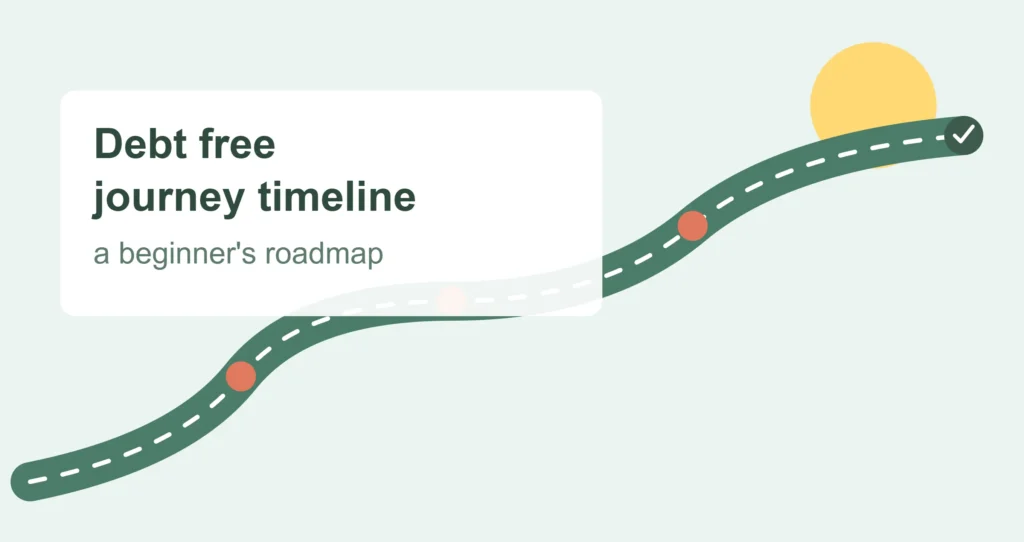
Here’s the thing most advice skips: debt payoff isn’t just a math problem, it’s a patience problem. A debt free journey timeline for beginners gives you checkpoints, and checkpoints are what keep you from quitting in month four when the excitement wears off.
Without a timeline, debt feels infinite. With one, it becomes a series of finish lines. That mental shift alone is why people who write out a plan tend to stick with it longer than people who just “try to pay more when they can.”
Month 1-2: The Reality Check Phase
This is where most debt free journey timelines for beginners actually start — not with payments, but with numbers.
In these first two months, you’re doing three things:
- Listing every debt, balance, interest rate, and minimum payment
- Tracking every dollar you spend for at least 30 days
- Choosing a payoff method (snowball, avalanche, or a hybrid)
A lot of people assume this step is optional, that they can “just start paying extra” and figure it out later. But here’s what actually happens: without exact numbers, people underestimate their debt by thousands of dollars and burn out early because their real timeline is longer than they expected.
A Quick Note on Method Choice
The debt snowball (smallest balance first) tends to work better for motivation. The debt avalanche (highest interest first) saves more money mathematically. Neither is “wrong” — pick the one you’ll actually follow for the next 12+ months.
Month 3-6: The Grind Starts Showing Up
By month three, the novelty is gone. This is usually the point where people either lock in or quietly fall off.
Here’s a bit of pushback against common advice: a lot of finance content tells you to “cut out lattes and subscriptions” like that’s the secret. Honestly, for most people carrying real debt — four, five figures — trimming $9 subscriptions barely moves the needle. What actually moves the needle in months three through six is increasing income or restructuring a big fixed cost, like refinancing a car or negotiating a bill.
If your income is irregular — freelance, commission, gig work — this stretch gets trickier, which is worth addressing directly.
How to Make a Monthly Budget With Irregular Income
If you’re one of the many people trying to follow a debt free journey timeline for beginners on inconsistent pay, standard budgeting advice (“just allocate 20% to debt”) doesn’t really apply. Instead:
- Calculate your lowest-earning month from the past 12 months and budget off that number
- Treat anything above that baseline as a bonus payment toward debt
- Build a small buffer fund first (even $500) so a slow month doesn’t force you to use credit again
This approach keeps your debt free journey timeline for beginners realistic instead of built on a “best case” income month that might not repeat.
Month 6-12: Momentum and the First Real Milestone
Somewhere around month six to nine, most beginners hit their first fully paid-off account. This is a big deal — not just financially, but psychologically. It’s proof the plan works.
A common mistake here: people take the “extra” money freed up from that paid-off debt and quietly let it drift back into spending instead of rolling it into the next balance. If you’re serious about your timeline, that rollover step is non-negotiable.
By the twelve-month mark, a realistic debt free journey timeline for beginners usually shows 25-40% of the original total debt eliminated, depending on income, interest rates, and how aggressive the payments were.
Year Two and Beyond: The Long Middle Stretch
This is the part nobody puts in headlines because it’s not exciting. Year two is where most of the actual dollar amount disappears, but it’s also where motivation naturally dips.
A few things help here:
- Revisit your numbers every 90 days, not daily — daily checking creates anxiety without adding useful information
- Automate minimum payments so a missed month never derails progress
- Celebrate paid-off accounts out loud, even small ones
If you’re also tackling debt, a solid monthly budget makes every stage of this easier — it’s worth building one alongside your payoff plan rather than after it.
What a Realistic Debt Free Timeline Actually Looks Like
To put real numbers on this: someone with $20,000 in combined credit card and personal loan debt, paying $600 a month beyond minimums, is typically looking at somewhere between 3 to 4 years to be fully debt free, depending on interest rates. That’s not a guess meant to discourage you — it’s the kind of number a real debt free journey timeline for beginners should include, because vague timelines are what cause people to quit.
Your number will be different. That’s fine. The point isn’t to match someone else’s pace — it’s to know your own.
Where to Go From Here
If there’s one takeaway from all of this, it’s that your debt free journey timeline for beginners doesn’t need to be perfect — it needs to be written down. Pull out your actual numbers this week, pick a method, and give yourself an honest, realistic date. That single step is usually what separates people who get out of debt from people who just keep meaning to.
Read This
How to Negotiate Credit Card Debt Settlement
FAQS
How long does it usually take to become debt free as a beginner?
It depends heavily on total debt, interest rates, and how much extra you can pay monthly — but most beginners following a structured plan see meaningful progress within 6-12 months and full payoff somewhere between 2-5 years.
What’s the first step in a debt free journey for beginners?
Listing every debt with its balance, interest rate, and minimum payment. You can’t build an accurate timeline without knowing exactly what you’re working with.
Is the debt snowball or avalanche method better for beginners?
Neither is objectively better — the snowball method tends to keep beginners motivated with quick wins, while the avalanche method saves more on interest over time. The best method is the one you’ll stick with consistently.