Here’s a number that surprises most people: you don’t need a portfolio, a degree, or five years of “professional experience” to make your first $200 freelancing Freelance Jobs for Beginners With No Experience. You need one client willing to give you a shot, and a way to prove you can do the work once they do. That’s it.
I’ve talked to a lot of people who stall out before they even start because they’re convinced freelance jobs for beginners with no experience basically don’t exist — that every gig posting wants three years of history and a stacked resume. Some do. Most don’t. Plenty of small businesses and busy professionals just want someone reliable who shows up and does decent work at a fair price. That’s a much lower bar than people assume.
This isn’t about get-rich-quick nonsense. It’s about realistic entry points, what they actually pay, and how to stop spinning your wheels applying to jobs you’re not ready for yet.
Why “No Experience” Isn’t the Dealbreaker You Think It Is
A lot of people assume clients only hire freelancers with years of proven work, but here’s what actually happens: most beginner-friendly clients care more about communication and turnaround time than your resume. If you respond quickly, follow instructions, and deliver on time, you’re already ahead of a good chunk of the freelance pool.
That said, I’ll push back on some popular advice here — the “just fake it till you make it” crowd will tell you to claim experience you don’t have. Don’t. Undercutting your credibility on day one costs you more than starting honest and small. Clients can tell, and a bad first review follows you.
Best Freelance Jobs for Beginners With No Experience
Some freelance jobs for beginners with no experience require almost zero setup cost and let you learn on the job. A few solid starting points:
- Virtual assistant work — inbox management, scheduling, data entry. Low skill barrier, steady demand.
- Proofreading and editing — if you have a decent eye for grammar, this is an easy first gig.
- Transcription — slow at first, but it teaches discipline and pays per audio minute.
- Social media scheduling — posting and light content calendars for small businesses.
- Basic graphic design — using templates in Canva counts as a real starting skill.
- Simple writing or blog editing — even without clips, you can write sample pieces to show tone and clarity.
None of these require a fancy setup. A laptop, a stable internet connection, and about an hour a day of focused work is enough to get moving.
How Much These Actually Pay
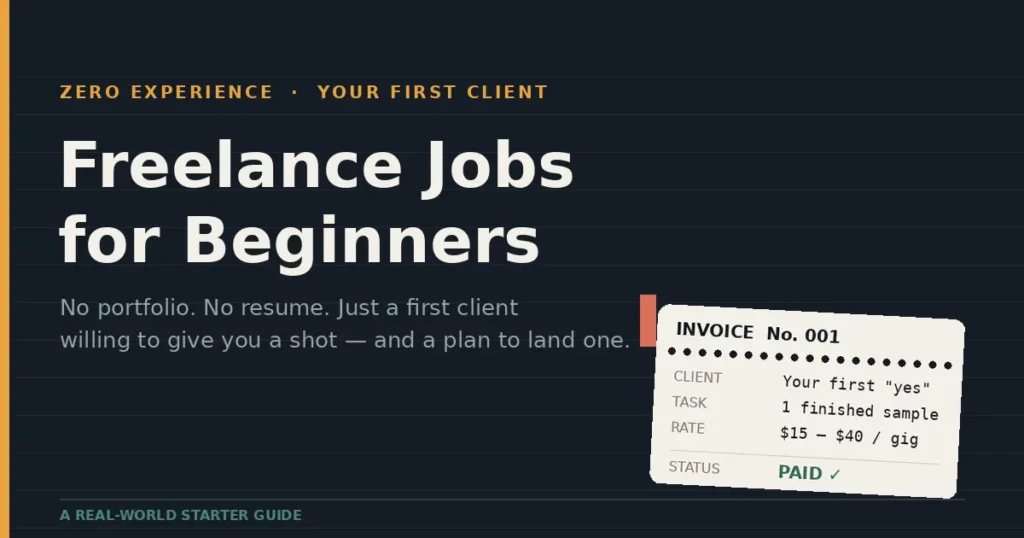
Don’t expect $50 an hour out of the gate. Realistically, beginner freelance jobs often start somewhere in the $10–$25 per hour range, or a flat project fee like $15–$40 for a short blog post or a one-off design task. It’s not glamorous, but it adds up, and rates climb fast once you have five or six completed jobs behind you.
How to Actually Land Your First Client
Getting hired with zero history feels like the hardest part, but it’s mostly a numbers-and-proof problem, not a skill problem.
- Create two or three sample pieces of work, even if unpaid, to show what you can do.
- Pick one platform (not five) and build a complete, specific profile — vague profiles get skipped.
- Apply to smaller, lower-competition listings first instead of the flashy high-budget ones.
- Send short, personalized pitches instead of copy-pasted templates.
- Deliver your first project slightly ahead of deadline. First impressions carry weight.
Once you land that first review, everything after gets easier. Clients trust other clients’ opinions more than your own pitch.
Managing Money When Your Income Isn’t Steady Yet
This is the part beginners underestimate. Freelance income doesn’t arrive like a paycheck — it’s lumpy, unpredictable, and sometimes late. Learning how to make a monthly budget with irregular income early on will save you a lot of stress later.
The simplest approach: budget off your lowest-earning month, not your best one. Take your smallest monthly total from the last few months (or your first realistic estimate if you’re brand new), and build your fixed expenses around that number. Anything you earn above it becomes a buffer, not spending money. If you’re also tackling debt at the same time, having that buffer already built makes paying it down far less stressful, since you’re not scrambling every time a slow month hits.
A basic system that works for a lot of new freelancers:
- Separate “business” and “personal” money, even in two basic checking accounts.
- Set aside a percentage of every payment for taxes before you touch the rest.
- Keep a small cash cushion (even $300–$500 to start) so a slow week doesn’t derail your bills.
This article is for informational purposes only and does not constitute financial, investment, or legal advice, so treat these as starting frameworks rather than fixed rules for your exact situation.
Staying Consistent Once You’ve Started
The freelancers who make it past month three aren’t necessarily the most talented — they’re the ones who kept showing up when the work was boring or slow. Treat it like a part-time job with real hours, not a side hobby you do when you feel inspired.
Track what’s working. If a certain type of pitch gets responses and another doesn’t, adjust. Small, steady improvements beat waiting for the “perfect” gig to appear.
Your Next Step
You don’t need to have it all figured out before you start — you need one finished sample and one sent pitch. Pick a single platform, write one honest profile, and send three pitches this week. That’s the whole first move.
Read This
Best Side Hustles for Stay at Home Moms
FAQS
Can I really get a freelance job with zero work experience?
Yes. Many clients hiring for entry-level freelance jobs for beginners with no experience care more about reliability and clear communication than a formal résumé.
What’s the easiest freelance job to start with no skills?
Virtual assistant work, data entry, and transcription tend to have the lowest barrier to entry since they rely on organization and attention to detail rather than specialized training.
How long does it take to get your first paying freelance client?
It varies, but most beginners land their first paid gig within two to six weeks of consistent daily applying and pitching, especially if they start with smaller, less competitive listings.