Let’s say your paycheck lands and the number reads $3,000 a month. Rent is due on the first, your phone bill auto-drafts on the third, and somehow there’s a birthday dinner on the fifth 50/30/20 Budget Rule Example for a $3000 Salary. Where is all of it supposed to go?
That’s exactly what the 50/30/20 budget rule is built to answer. It’s not a magic formula, and it won’t make $3,000 stretch further than it physically can in an expensive city — but it gives you a starting framework instead of just guessing every month. Below is a full 50/30/20 budget rule example for a $3000 salary, broken down dollar by dollar, along with where the rule tends to break down in real life and how to adapt it.
This article is for informational purposes only and does not constitute financial, investment, or legal advice.
What the 50/30/20 Budget Rule Actually Means
The 50/30/20 rule splits your take-home pay into three buckets:
- 50% for needs — rent, groceries, utilities, minimum debt payments, insurance
- 30% for wants — dining out, streaming services, hobbies, that impulse Amazon order
- 20% for savings and debt payoff — emergency fund, retirement, extra payments on loans
It was popularized by Senator Elizabeth Warren in a book about family finances, and it caught on because it’s simple. You don’t need seventeen budget categories to use it — just three.
50/30/20 Budget Rule Example for a $3000 Salary
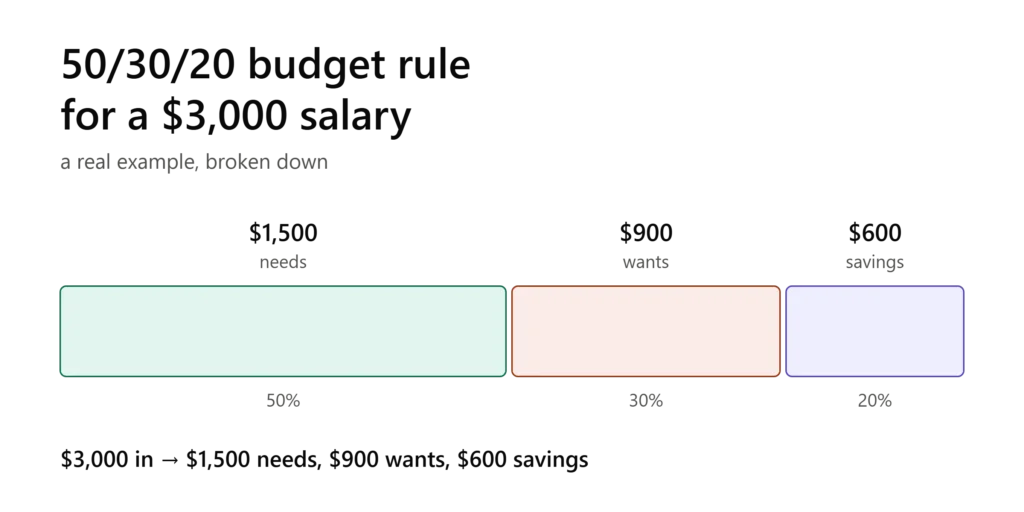
Here’s how a 50/30/20 budget rule example for a $3000 salary actually looks once you run the numbers.
Needs: $1,500 a Month
This is your non-negotiable bucket. On a $3,000 salary, that’s $1,500 for:
- Rent or mortgage
- Utilities (electric, water, internet)
- Groceries
- Minimum payments on debt
- Car payment and insurance
- Health insurance premiums
If you live somewhere like Austin or a mid-sized Midwest city, $1,500 might genuinely cover rent plus everything else. If you live in San Francisco or New York, rent alone can eat that entire bucket — more on that pushback in a minute.
Wants: $900 a Month
This is the fun bucket, and it’s $900 on a 50/30/20 budget rule example for a $3000 salary. Think:
- Restaurants and takeout
- Streaming subscriptions
- Concert tickets or hobbies
- New clothes that aren’t strictly necessary
- Travel savings for a trip later this year
A lot of people assume the “wants” category is where you should cut first when money’s tight, but here’s what actually happens — most people cut wants down to zero for a month, feel deprived, and then overspend the following month to compensate. A small, planned wants budget is usually more sustainable than none at all.
Savings and Debt: $600 a Month
The last $600 goes toward building your future self some breathing room:
- Emergency fund contributions
- Retirement accounts (401k or IRA)
- Extra payments toward credit card or student loan debt
- General savings goals
If you’re also tackling high-interest debt, having a working budget in place first makes the debt payoff plan actually stick, instead of falling apart the moment an unexpected expense shows up.
Where This Budget Rule Falls Apart in Real Life
Here’s the pushback: the 50/30/20 split assumes your needs will fit into half your income. In a lot of the country right now, that’s just not realistic. If rent alone is $1,400 of a $3,000 salary, you’ve already blown past the “needs” bucket before groceries or gas even enter the picture.
So don’t treat the 50/30/20 budget rule example for a $3000 salary as a rulebook you failed to follow. Treat it as a reference point. If your needs run closer to 65% some months, that’s not a personal failure — it’s a math problem, and the fix is usually shrinking the wants bucket temporarily, not shaming yourself into cutting things you actually need.
How to Make a Monthly Budget with Irregular Income
Not everyone gets a clean $3,000 every single month. Freelancers, gig workers, and hourly employees deal with income that swings up and down, which makes a rigid 50/30/20 split harder to apply directly.
If that’s you, here’s how to make a monthly budget with irregular income without losing your mind:
- Budget off your lowest realistic monthly income, not your average or best month
- Build a buffer account that smooths out the gaps between high and low months
- Apply the 50/30/20 percentages to whatever actually lands in your account, not what you expect
- Treat any month above your baseline as a bonus that goes straight to savings or debt
This approach turns an unpredictable paycheck into something closer to a stable $3,000-a-month rhythm, even if the actual deposits bounce around.
Adjusting the 50/30/20 Split When $3000 Doesn’t Stretch
If you’ve run the numbers and the standard 50/30/20 budget rule example for a $3000 salary just doesn’t fit your city or situation, try a modified version instead — something like 60/20/20 or 65/15/20, where needs get more room and wants get trimmed. The 20% savings bucket is usually the last thing worth cutting, even if it means dropping to 10% temporarily while you stabilize.
The goal isn’t perfect adherence to a ratio someone else came up with. It’s having a framework that tells you where your money is actually going, instead of finding out at the end of the month that you’re not sure.
Read This
Best Cashback Apps That Actually Pay Out
FAQS
Is the 50/30/20 rule realistic on a $3000 salary?
It depends heavily on where you live. In lower cost-of-living areas, a $3,000 salary can often fit the 50/30/20 split fairly comfortably. In high-rent cities, the needs category usually needs to expand beyond 50%.
What counts as a “need” versus a “want” in the 50/30/20 rule?
Needs are expenses you can’t reasonably avoid — housing, groceries, utilities, insurance, minimum debt payments. Wants are anything beyond that baseline, even things that feel routine, like a daily coffee or a streaming subscription.
Should I follow 50/30/20 exactly or just use it as a guideline?
Most people use it as a guideline rather than a strict rule. The real value is in having three clear categories to sort spending into, not in hitting the percentages exactly every single month.