Here’s a number that stops people cold: the average person can’t tell you, within $200, what they spent last month Free Budget Template for Beginners (That Actually Works). Not because they’re careless. Because nobody ever handed them a system that made tracking easy instead of tedious. That’s the whole problem a free budget template for beginners is supposed to solve, and most of them don’t.
If you’ve downloaded a spreadsheet before and abandoned it by week two, you’re not alone. A lot of people assume the issue is discipline, but here’s what actually happens: the template was built for someone with a steady paycheck and predictable bills, and real life is messier than that. This article walks through a free budget template for beginners that’s simple enough to stick with, plus how to adapt it if your income bounces around month to month.
Why Most Beginner Budgets Fall Apart
Most budgeting advice assumes a tidy world. Same paycheck every two weeks. Same rent. Same grocery bill, give or take ten bucks. For a lot of people, that’s just not reality.
Freelancers, gig workers, servers living on tips, anyone on commission — irregular income throws a wrench into the standard advice. You can’t allocate “20% to savings” when you don’t know if this month brings in $2,200 or $4,100. So the first template gets abandoned, and the beginner assumes budgeting just isn’t for them. It’s not a willpower issue. It’s a mismatch between the tool and the situation.
The Free Budget Template for Beginners, Explained
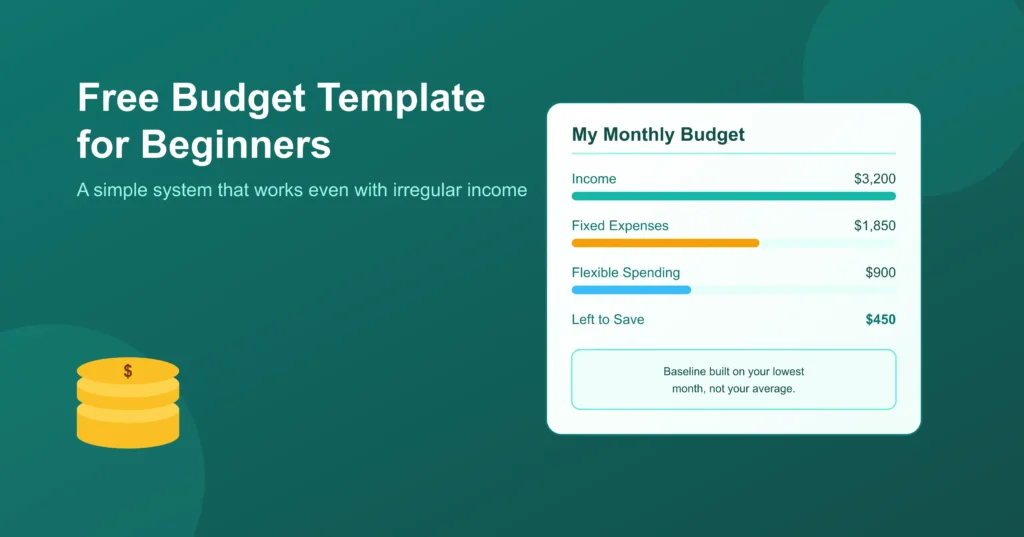
A good free budget template for beginners has three parts, and nothing more complicated than that:
- Income (what actually landed in your account)
- Fixed expenses (rent, insurance, minimum debt payments)
- Flexible spending (groceries, gas, the stuff that moves around)
That’s it. No 40-tab spreadsheet with color-coded macros. The point of a free budget template for beginners is that you can open it, fill it in, and understand it in under ten minutes.
Setting Up Your First Month
Start by writing down every fixed expense you’re locked into. Rent or mortgage, phone bill, subscriptions, minimum debt payments. Add those up first, because they’re non-negotiable and they anchor everything else.
Then track flexible spending for two to three weeks before you try to set a number for it. Guessing “I probably spend $400 on groceries” almost always undercounts. Most people are closer to $550-$600 once gas station snacks and the extra Target run get counted.
How to Make a Monthly Budget With Irregular Income
This is where a free budget template for beginners needs a small but important tweak if your paychecks aren’t consistent. Instead of budgeting off this month’s income, budget off your lowest realistic month from the past six to twelve months.
Here’s how that works in practice:
- Pull your last 6-12 months of income and find the lowest one
- Build your monthly budget using that number as your baseline
- Cover fixed expenses and essential flexible spending first, using only that baseline
- Anything earned above the baseline in a good month goes straight to savings, debt, or a buffer fund
- Keep a running “income buffer” account so a slow month doesn’t derail you
This approach is sometimes called reverse budgeting or baseline budgeting, and it’s genuinely one of the better free budget template for beginners strategies if your income isn’t fixed. You’re not trying to predict the future. You’re building a floor that won’t collapse on a bad month.
I’ll push back on one piece of common advice here: a lot of guides tell irregular earners to “average” their income over the year and budget off that. I’d skip that approach. Averages hide your worst months, and your worst month is the one that actually breaks a budget. Baseline off the low end, not the middle.
Making the Template Actually Stick
A free budget template for beginners only works if you touch it regularly. Once a week is enough — you don’t need to log every latte the day you buy it.
Set a recurring 15-minute check-in, maybe Sunday night, where you update the numbers and glance at what’s left in flexible spending. If you’re also tackling debt, having a working budget makes that a lot easier, since you’ll actually be able to see how much you can realistically throw at a balance each month.
Common Adjustments Beginners Need
A few tweaks that make a real difference early on:
- Round flexible spending estimates up, not down
- Build a small buffer category (even $50) for the expenses you forgot existed
- Revisit fixed expenses every few months — subscriptions creep
A Quick Word on Expectations
Your first month with any free budget template for beginners is going to be a little off. That’s normal, not a failure. You’re calibrating, not failing a test. By month three, the numbers usually start reflecting reality pretty closely.
This article is for informational purposes only and does not constitute financial, investment, or legal advice. Everyone’s situation is different, and a licensed professional can help with decisions specific to your finances.
Read This
Best Budgeting Method for Beginners (That Actually Sticks)
FAQS
What is the best free budget template for beginners?
The best one is whichever template you’ll actually open every week. A simple three-category system (income, fixed, flexible) tends to outperform complicated spreadsheets for most beginners, because it’s easier to maintain long-term.
How do I budget if my income changes every month?
Budget off your lowest recent month instead of your average or your best month. That baseline approach protects you from slow months while letting extra income in good months go toward savings or debt.
Do I need an app, or is a spreadsheet enough?
A spreadsheet or printable template is enough for most beginners. Apps can help with automatic tracking, but the habit of reviewing your numbers weekly matters more than which tool you use.