Here’s a number that stops most people cold: $400. That’s roughly what it costs to cover a surprise car repair or ER copay for a lot of households, and it’s Best Budgeting Method for Beginners also the amount that, according to years of Fed survey data, a huge chunk of Americans say they couldn’t pay for out of pocket without borrowing. If that number makes you a little uneasy, you’re exactly who this article is for.
If you’ve Googled the best budgeting method for beginners before, you’ve probably landed on ten different systems, three apps, and a spreadsheet someone’s cousin swears by. It’s a lot. So let’s cut through it. This isn’t about finding the “perfect” system — it’s about finding the one you’ll actually use in month three, not just week one.
Why Most Beginner Budgets Fail Fast
A lot of people assume budgeting means tracking every latte and beating themselves up over a $6 impulse buy. But here’s what actually happens: the budget gets too detailed, too rigid, and by week two it’s abandoned in a browser tab nobody opens again.
The best budgeting method for beginners isn’t the most precise one. It’s the one with the lowest friction. If checking your budget feels like a chore, you won’t do it — and a budget you don’t check is just a document.
The Best Budgeting Method for Beginners: Start With Percentages, Not Line Items
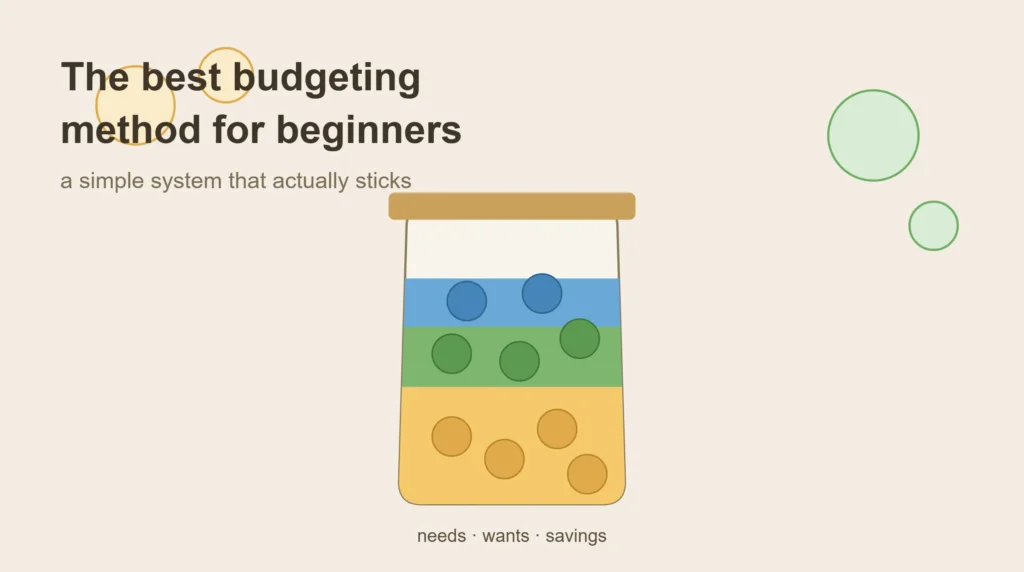
For most people just starting out, a percentage-based system beats a category-by-category spreadsheet. The most common version is the 50/30/20 rule:
- 50% of your take-home pay goes to needs (rent, groceries, utilities, minimum debt payments)
- 30% goes to wants (eating out, subscriptions, hobbies)
- 20% goes to savings and extra debt payoff
You don’t need to hit these numbers exactly on day one. Think of them as a compass, not a courtroom. If your rent alone eats 45% of your paycheck because you live somewhere expensive, that’s real life, not failure — you’ll just lean the “wants” category tighter to compensate.
Why Percentages Work Better for New Budgeters
Percentages scale automatically. If you get a raise, a bonus, or a slow month, the math adjusts itself instead of forcing you to rebuild a whole spreadsheet. That’s a big reason this approach tends to outlast more rigid systems for people who are new to budgeting altogether.
A Little Pushback: Zero-Based Budgeting Isn’t Always Better
You’ll see a lot of finance content push zero-based budgeting, where every single dollar gets assigned a job before the month starts. It’s a genuinely powerful method — but for someone brand new to budgeting, it can backfire. It demands a level of precision and weekly maintenance that’s hard to sustain when you’re still building the habit. Start simpler, get consistent, then graduate to zero-based budgeting later if you want more control. There’s no prize for jumping straight to the hardest version.
How to Make a Monthly Budget With Irregular Income
Percentages get trickier when your paycheck isn’t the same every month — freelancers, tipped workers, and commission-based earners deal with this constantly. If that’s you, here’s a practical way to adapt the best budgeting method for beginners to a moving target:
- Calculate your baseline: Look at your lowest-earning month from the past six to twelve months. That becomes your “safe” budget floor.
- Fund fixed costs first: Rent, insurance, minimum debt payments, and utilities get paid from that baseline income before anything else.
- Build a income buffer fund: In higher-earning months, stash the extra into a separate account. This becomes your paycheck stabilizer during leaner stretches.
- Treat “wants” as flexible: Let discretionary spending expand and contract with what actually comes in that month, not what you hope comes in.
This approach takes the emotional guesswork out of irregular income. Instead of budgeting off your best month and panicking in your worst one, you’re budgeting off reality.
Tools That Make This Easier (Without Overcomplicating It)
You don’t need fancy software to start. A lot of beginners do fine with:
- A basic budgeting app that auto-categorizes transactions
- A simple shared spreadsheet template
- Even a notes app with three running totals: needs, wants, savings
The tool matters far less than the consistency. Pick whichever one you’ll actually open once a week, not the one with the most features.
If you’re also tackling debt at the same time, having this kind of budget in place makes choosing between payoff strategies a lot more manageable, since you’ll already know exactly how much is realistically available each month.
Making It Stick Past Month One
The biggest predictor of long-term budgeting success isn’t the method — it’s the review habit. Set a recurring 10-minute check-in, weekly or biweekly, where you glance at what came in and what went out. No spreadsheet gymnastics required, just a quick gut check.
Expect some months to be messy. That’s normal, not a sign you’re bad at this. The goal isn’t a flawless budget; it’s a system flexible enough to bend without breaking when life happens.
This article is for informational purposes only and does not constitute financial, investment, or legal advice.
Your Next Step
Pick one method from this article, apply it to just next month’s paycheck, and skip the spreadsheet perfectionism entirely. A budget that’s 80% accurate and gets checked weekly beats a “perfect” one that gets abandoned by the 15th.
Read This
How to Budget Your Money Step by Step (Even With Irregular Income)
FAQS
What is the best budgeting method for beginners with no savings?
The 50/30/20 method works well here — it naturally carves out a savings percentage from day one, even if it starts small, without requiring you to track every category perfectly.
How do I budget if my income changes every month?
Base your fixed expenses on your lowest recent earning month, build a buffer fund during higher-income months, and let discretionary spending flex with whatever actually comes in.
Is the 50/30/20 rule realistic if I live in an expensive city?
Not always exactly — and that’s fine. Use it as a starting ratio, then shift the percentages to fit your actual cost of living rather than forcing your rent into a number that doesn’t match reality.