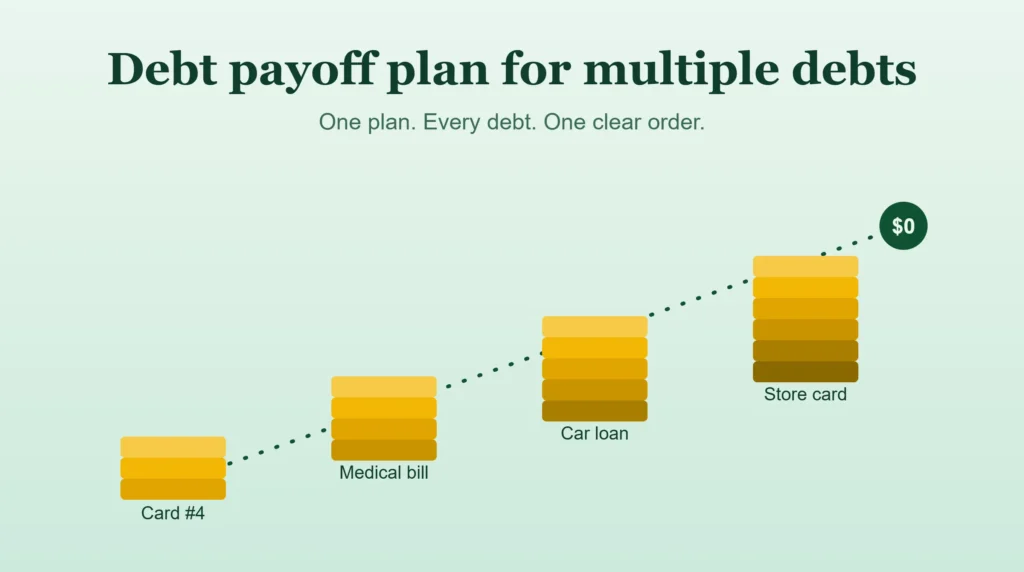
Picture this: you’ve got a $4,200 credit card, a $9,800 car loan, a $2,100 medical bill, and a store card you forgot you even opened Debt Payoff Plan for Multiple Debts. Four different due dates, four different minimum payments, and a growing sense that you’re just treading water. If that sounds familiar, you don’t need a lecture — you need an actual debt payoff plan when you have multiple debts, one you can follow without a finance degree.
Here’s the thing nobody tells you upfront: the hardest part isn’t math. It’s decision fatigue. When you owe five different places money, every extra dollar becomes a tiny crisis of “where does this go?” A solid debt payoff plan when you have multiple debts exists specifically to end that internal debate before it starts.
Why a Debt Payoff Plan When You Have Multiple Debts Actually Matters
Minimum payments are designed to keep you paying for a long time — that’s not a conspiracy theory, it’s just how interest amortization works. If you’re only sending in minimums across four accounts, you could be years away from actually being debt-free, even if the total balance doesn’t feel enormous.
A real plan does three things:
- Tells you exactly which debt gets extra money each month
- Keeps the rest on autopilot so nothing gets missed
- Gives you a finish line you can actually picture
Without that structure, most people default to paying whichever bill feels loudest that week. It’s understandable, but it’s expensive.
Step 1: List Every Debt in One Place
Before you pick a strategy, get honest numbers down. For each debt, write out the balance, interest rate, minimum payment, and due date. A lot of people assume they know their numbers well enough to skip this step, but here’s what actually happens — they underestimate a rate by a few points or forget a balance entirely, and the whole plan gets built on shaky ground.
Use a notes app, a spreadsheet, or plain paper. It doesn’t need to be pretty. It needs to be complete.
Step 2: Choose Your Method (Snowball vs. Avalanche)
This is where a lot of debt payoff plan when you have multiple debts guides get preachy, insisting there’s one “correct” answer. There isn’t.
- Debt Snowball — Pay minimums on everything, then throw extra cash at your smallest balance first, regardless of interest rate. Once it’s gone, roll that payment into the next smallest.
- Debt Avalanche — Same idea, but you target the highest interest rate first. Mathematically, this saves you more money over time.
Here’s my gentle pushback on the popular advice: everyone online tells you avalanche is objectively “smarter” because it saves more in interest. Technically true. But if you’ve got five debts and the avalanche method means your first win doesn’t come for eight months, you’re statistically more likely to quit. Snowball’s quick psychological wins keep real people — not spreadsheets — actually finishing the plan. Pick the one you’ll stick with, not the one that wins an argument on paper.
A Hybrid Option Worth Considering
Some people split the difference: knock out one small debt for a quick morale boost, then switch to avalanche order for the rest. There’s no rule against mixing methods — the only rule is consistency.
Step 3: Automate the Minimums, Then Attack One Target
Once you’ve chosen your order, set every account to autopay its minimum. This protects your credit score and takes the “did I forget something” anxiety off the table.
Then take whatever extra you can find — even $75 a month makes a real dent over a year — and send it exclusively to your target debt. Not spread thin across everything. Concentrated force beats scattered effort here, the same way it does with almost any goal.
Step 4: Build a Buffer Before You Snowball Everything
One thing that trips people up: throwing every spare dollar at debt with zero cushion left in checking. Then one unexpected $300 car repair shows up, and suddenly it’s back on a credit card, undoing progress.
Before you go aggressive, keep even a small buffer — $500 to $1,000 — sitting untouched. It’s not glamorous, but it’s what keeps a debt payoff plan when you have multiple debts from collapsing the first time life gets messy.
Step 5: Track Progress Somewhere Visible
Motivation fades around month three for most people — that’s just normal, not a personal failing. Combat it by tracking progress somewhere you’ll actually see it: a printed chart on the fridge, a recurring calendar note, a simple spreadsheet you update on the first of the month.
Watching total debt shrink, even slowly, does more for follow-through than any amount of willpower.
What If Your Income Isn’t Steady?
If your paychecks vary — freelance work, tips, commission, seasonal gigs — a rigid payoff plan can feel impossible some months. In that case, base your minimums on your lowest realistic income month, and send bonus payments during stronger months. And if you’re also tackling debt, learning how to make a monthly budget with irregular income first makes the whole payoff plan far less stressful, since you’re not guessing what you can afford to send each month.
Your Next Move
You don’t need to overhaul your entire financial life this week. Pick one method, list your debts tonight, and send one extra payment toward your first target before the month is out — that single action is what turns a plan on paper into actual progress.
Read This
Debt Free Journey for Beginners: A Real Starting Guide
FAQS
What is the best debt payoff plan when you have multiple debts?
There’s no single “best” plan — snowball tends to work well for people who need motivation from quick wins, while avalanche saves more money for people who can stay patient without early results.
Should I pay off debt or save money first?
Most people benefit from a small emergency buffer first, then aggressive debt payoff, so unexpected expenses don’t force new debt right back onto the cards you’re trying to pay off.
How long does it take to pay off multiple debts?
It depends entirely on your total balance, interest rates, and how much extra you can consistently put toward your target debt each month — even small, steady amounts add up faster than people expect.