I still remember staring at four credit card statements spread out on my kitchen table, $14,300 in total, and feeling absolutely nothing but dread Free Debt Payoff Tracker Printable. Spreadsheets felt cold. Apps felt like one more screen demanding my attention. What actually got me moving was something almost embarrassingly simple: a printed page I could color in with a highlighter every time I made a payment.
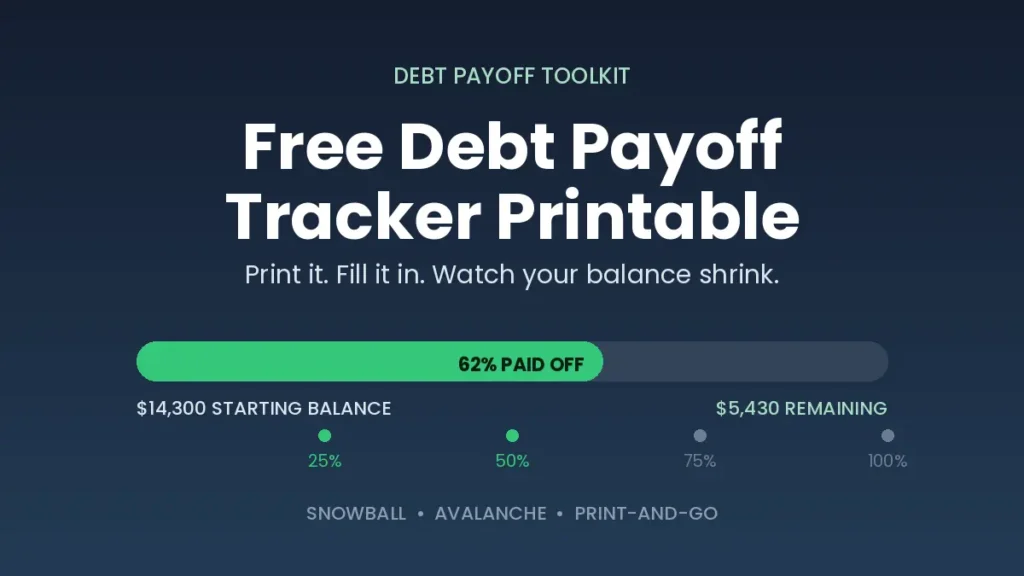
That’s the whole appeal of a free debt payoff tracker printable — it turns an abstract, anxiety-inducing number into something visual and trackable. You’re not just “paying down debt” in some vague sense. You’re filling in a bar, checking a box, watching a total shrink in ink you can actually see.
In this guide, I’ll walk you through why a printable tracker works better than most people expect, how to pick or build one that fits your actual life, and how to use it so it doesn’t end up shoved in a drawer by week three.
Why a Printable Tracker Beats Another Budgeting App
Apps are great for automation. They’re not always great for motivation. There’s research in behavioral psychology suggesting that visible, physical progress markers — think fitness trackers, savings jars, sticker charts — trigger a stronger sense of accomplishment than digital notifications ever do.
A free debt payoff tracker printable works the same way. You tape it to the fridge or tuck it inside your planner, and every payment becomes a small, satisfying act instead of an invisible bank transfer.
A quick note here, and it’s a bit of pushback against common advice: a lot of finance blogs will tell you to track every single debt on one giant master printable. Honestly? For most people, that backfires. If you’ve got six creditors, one enormous chart can feel more overwhelming than the debt itself. I’ve found it works better to track your top one or two priority debts front and center, with the rest listed underneath in a smaller “on deck” section.
What a Good Debt Payoff Tracker Printable Should Include
Not all printables are created equal. Before you download the first free debt payoff tracker printable you find on Pinterest, check that it actually has these basics:
- A clear starting balance and target payoff date
- Space to log each payment, not just a running total
- A visual element (bar, thermometer, or grid) you fill in as you pay
- Room for interest rate and minimum payment, so you’re not tracking blind
- A spot to note which method you’re using (snowball, avalanche, or your own hybrid)
If a printable is missing that last point, it’s worth adding yourself. Knowing why you’re paying a debt in a certain order matters almost as much as the paying itself.
How to Choose Between Snowball and Avalanche on Your Tracker
This is the part people overthink. The debt snowball method has you pay off your smallest balance first, regardless of interest rate, for quick psychological wins. The debt avalanche method has you attack the highest-interest debt first, which saves more money mathematically.
Here’s an honest take: the “best” method is whichever one you’ll actually stick with. I’ve watched people abandon a mathematically perfect avalanche plan because it took eight months to see any real movement, and I’ve watched snowball fans get impatient once the easy wins ran out. Your free debt payoff tracker printable should be flexible enough to support either approach — or a blend, where you knock out one tiny balance first for momentum, then switch to avalanche mode.
A Simple Way to Set It Up in Five Steps
- List every debt with its balance, interest rate, and minimum payment.
- Choose your order (snowball, avalanche, or a hybrid of both).
- Print your tracker and fill in your current balances by hand.
- Log every payment the same day you make it, no batching it up for later.
- Recalculate your “debt-free date” every 30 days as balances shift.
That last step matters more than people realize. Seeing your projected payoff date get closer, even by a few weeks, is often what keeps a tracker in use past the first month.
Where Irregular Income Complicates the Picture
If your paycheck looks the same every two weeks, a debt tracker is fairly straightforward. But if you’re freelancing, working commission, or juggling gig income, the math gets trickier — and this is where a lot of printables quietly fail people.
The fix isn’t a fancier tracker. It’s pairing your debt tracker with a monthly budget with irregular income built around your lowest-earning month, not your average. You base your minimum obligations — debt payments included — on that leanest month, then treat anything above it as a bonus payment toward whichever debt you’re prioritizing. If you’re also tackling debt, having a solid budget system like this in place first makes the tracker so much easier to stick to.
Practically, that might mean your printable has a “base payment” column for lean months and a “bonus payment” column for the good ones. Simple addition, but it keeps you from overcommitting in July and scrambling in September.
Making the Tracker Actually Stick
A free debt payoff tracker printable only works if it stays visible. Here’s what tends to separate the people who use one for a year from the people who use one for a week:
- Keep it somewhere you’ll see daily — not filed away in a binder
- Update it the moment you make a payment, while the motivation is fresh
- Celebrate small milestones (25%, 50%, 75% paid off) instead of waiting for the finish line
- Pair it with a monthly check-in, even just 10 minutes, to review what’s working
None of this requires perfection. Missed a week of updates? Fill it in from memory and move on. The tracker is a tool to keep you engaged, not another thing to feel guilty about.
This article is for informational purposes only and does not constitute financial, investment, or legal advice. Everyone’s debt situation is different, and it’s worth talking to a financial professional if your situation is complex.
Final Thought
The most effective free debt payoff tracker printable isn’t the prettiest one you can find — it’s the one you’ll actually fill in every single week. Print one out this weekend, write in your real numbers, and put it somewhere you can’t ignore it.
Read This
Debt Payoff Plan for Multiple Debts: A Real Strategy
FAQS
Is a free debt payoff tracker printable actually effective, or is it just a gimmick?
It’s effective for a specific reason: it makes progress visible. For people who feel more motivated by physically marking something off than by checking an app, a printable often outperforms digital tools in terms of consistency.
Can I use a debt payoff tracker printable if my income changes every month?
Yes, but it works best when adapted. Build your base payments around your lowest-earning month and add a bonus column for stronger months, rather than assuming a flat payment every time.
Should I use one printable per debt or one master tracker for everything?
Either can work, but for most people with multiple debts, a hybrid is easiest: a detailed printable for your top one or two priority debts, and a simplified summary list for the rest.