Here’s a number that stops most parents in their tracks: the average family of four spends somewhere between $6,000 and $7,500 a month once you count housing, food, childcare, and the twenty small things nobody remembers to plan for Monthly Budget Breakdown for a Family of 4. If you’ve never actually written down a monthly budget breakdown for a family of 4, that number can feel abstract right up until it isn’t.
I’ve built budgets for families making $45,000 a year and families making $180,000 a year, and here’s the thing that surprises people every time: the percentages matter more than the paycheck. A family earning six figures can still be one bad month from overdraft if nothing’s written down. A family earning half that can build real savings if the plan is honest.
So let’s actually build one.
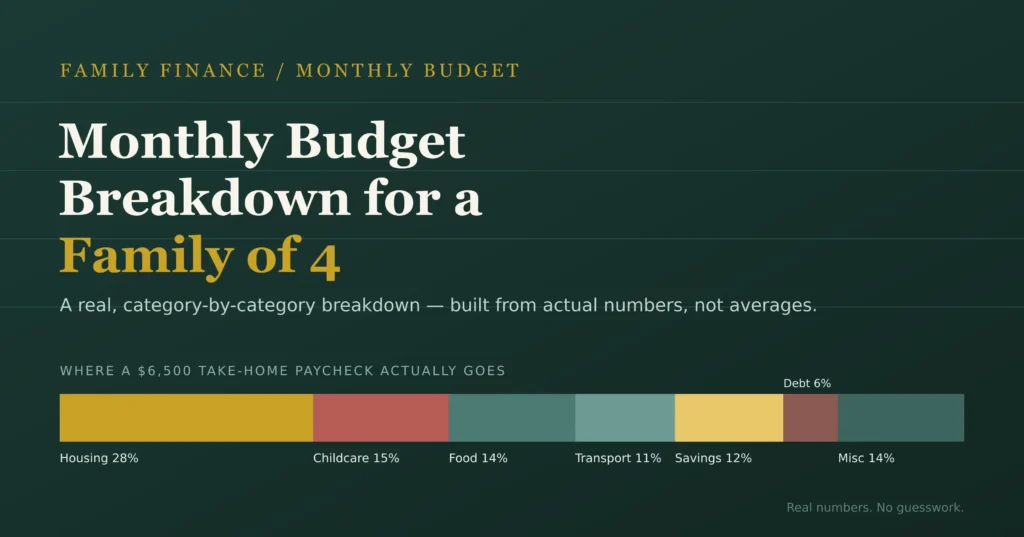
What a Realistic Monthly Budget Breakdown for a Family of 4 Looks Like
There’s no single “correct” monthly budget breakdown for a family of 4, because your rent in Boise isn’t your rent in Brooklyn. But there is a useful framework, and it starts with percentages of take-home pay rather than fixed dollar amounts:
- Housing (rent or mortgage, insurance, utilities): 25-30%
- Food (groceries plus a realistic amount for eating out): 10-15%
- Transportation (car payment, gas, insurance, maintenance): 10-15%
- Childcare and kids’ expenses: 10-20% (this one swings wildly)
- Debt payments beyond the mortgage: 5-10%
- Savings and investments: 10-15%
- Everything else (subscriptions, personal spending, gifts, the dentist you forgot about): 10-15%
A lot of people assume childcare is a “nice to have” line item you can shrink if money gets tight. It isn’t. For most working families it’s the second or third biggest expense in the house, right up there with rent. If your monthly budget breakdown for a family of 4 doesn’t give childcare its own honest line, the whole plan falls apart by week two.
A Sample Monthly Budget Breakdown for a Family of 4 Earning $6,500 Take-Home
Let’s put real numbers on it. Say your household brings home $6,500 a month after taxes.
- Housing: $1,800 (rent, utilities, renters or home insurance)
- Groceries and dining out: $900
- Transportation: $700
- Childcare: $1,000
- Debt payments (student loans, credit card): $400
- Savings (emergency fund plus retirement): $800
- Personal, subscriptions, and miscellaneous: $600
- Buffer/unplanned: $300
That adds up close to the full $6,500. Notice there’s a buffer line. Every monthly budget breakdown for a family of 4 needs one, because something always comes up — a school fundraiser, a flat tire, a birthday party for a kid you didn’t even know your kid was friends with.
Where This Budget Actually Breaks Down
Here’s my pushback on the popular advice you’ll see everywhere: the “50/30/20 rule” (50% needs, 30% wants, 20% savings) sounds clean, but it rarely survives contact with a real family. Childcare alone can eat past the “needs” allocation before you’ve bought a single grocery item. I’d rather see families build a monthly budget breakdown for a family of 4 around their actual bills first, then fit savings and wants around what’s left — not the other way around.
How to Make a Monthly Budget with Irregular Income
This is where a lot of families get stuck, especially if someone freelances, works commission, or picks up seasonal shifts. You can’t build a clean monthly budget breakdown for a family of 4 around a number that changes every 30 days. Here’s what actually works:
- Base your fixed bills (housing, insurance, minimum debt payments) on your lowest realistic month, not your best one.
- Build a “income smoothing” buffer account. In good months, anything above your baseline gets parked there instead of spent.
- In lean months, you pull from that buffer to keep bills paid on time.
- Review and adjust every 90 days rather than every single month — irregular income needs a longer lens to spot real patterns.
If you’re also carrying debt on top of irregular income, a solid budget makes that a lot easier to manage too, since you’ll actually know what you can put toward it without guessing.
Common Mistakes That Wreck a Family Budget
A few patterns show up again and again when I look at family budgets that aren’t working:
- Forgetting annual and semi-annual costs (car registration, holiday spending, back-to-school shopping) and only planning month to month
- Underestimating groceries for growing kids — a 10-year-old eats a lot more than people plan for
- Treating savings as “whatever’s left over” instead of a line item that gets paid first
- Not revisiting the budget after a raise, a new baby, or a move
None of this is about doing it wrong. It’s about giving yourself a plan that matches real life instead of a spreadsheet from three years ago.
Tools That Make This Easier
You don’t need anything fancy. A shared spreadsheet works fine if both partners actually update it. Apps like YNAB or a basic bank budgeting tool can automate the tracking part, which honestly is the part most people abandon by month two. The tool matters less than the habit of checking in — even fifteen minutes every Sunday keeps a monthly budget breakdown for a family of 4 from going stale.
This article is for informational purposes only and does not constitute financial, investment, or legal advice.
Where to Go From Here
Pick one category from your own numbers this week — just one — and write down what you actually spent versus what you assumed. That single gap is usually where the rest of your budget starts making sense.
Read This
How to Budget When You Live Paycheck to Paycheck
FAQS
How much should a family of 4 spend on groceries per month?
Most families land somewhere between $800 and $1,200 a month depending on location, kids’ ages, and how often you eat out versus cook at home.
What percentage of income should go to housing for a family of 4?
Aim for 25-30% of take-home pay, though this climbs higher in expensive cities and that’s okay as long as other categories flex to compensate.
How do I budget if my paycheck is different every month?
Build your fixed expenses around your lowest expected month, save the surplus from stronger months in a buffer account, and review the whole plan every quarter instead of monthly.