Picture this: you’ve got a $4,200 credit card at 24% APR, a $1,100 medical bill sitting at 0% because you’re on a payment plan, and a $9,800 car loan at 6% Debt Snowball vs Avalanche Method. You’ve got an extra $300 a month to throw at debt. Which one do you attack first?
That question is exactly why the debt snowball vs avalanche method debate exists, and honestly, it’s one of the few personal finance arguments where both sides have a legitimate point. This isn’t about right or wrong. It’s about knowing yourself well enough to pick the method you’ll actually stick with.
What Is the Debt Snowball Method?
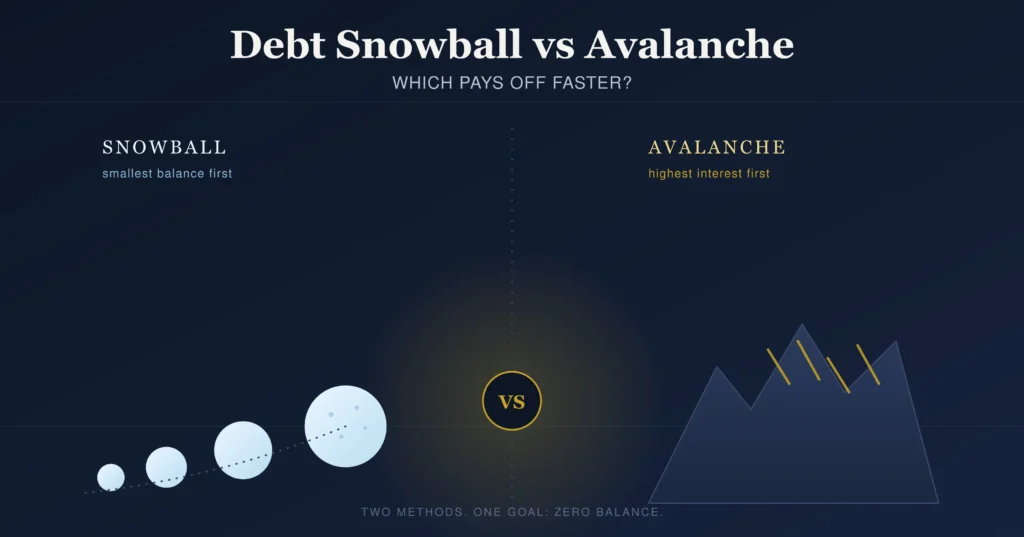
The snowball method has you list your debts from smallest balance to largest, ignoring interest rates completely. You pay minimums on everything except the smallest debt, and you throw every spare dollar at that one until it’s gone. Then you roll that payment into the next-smallest balance, and so on.
The appeal is simple: quick wins. Knocking out that $1,100 medical bill in three months feels like progress you can see, and for a lot of people, that feeling is the difference between sticking with a plan and quietly giving up on it around month four.
What Is the Debt Avalanche Method?
The avalanche method flips the order. You rank your debts by interest rate, highest to lowest, and put your extra money toward the debt costing you the most in interest first — regardless of the balance.
Mathematically, this is the more efficient choice. You pay less in total interest over the life of your debt, and in many cases, you get debt-free a few months sooner than you would with the snowball approach. If you’re the type of person who’s motivated by numbers rather than momentum, the avalanche method usually wins.
Debt Snowball vs Avalanche Method: The Real Numbers
Let’s go back to that $4,200 card at 24%, the $1,100 bill at 0%, and the $9,800 loan at 6%, with $300 a month available beyond minimums.
- With the avalanche method, you’d hit the 24% card first, saving roughly $600–$800 in interest over the payoff period compared to snowballing.
- With the snowball method, you’d clear the $1,100 bill in about three to four months, giving you an early psychological win before tackling the bigger balances.
Neither number is wrong. One saves you cash. The other keeps you in the game. That tradeoff is really the whole debate in a nutshell.
A Common Assumption Worth Pushing Back On
A lot of financial advice treats the avalanche method as the “correct” one and the snowball method as a consolation prize for people who can’t do math. I’d push back on that. Behavioral research on debt repayment (and plenty of anecdotal evidence from people who’ve actually done this) shows that completion rates matter more than optimization. A technically superior plan you abandon in month six is worse than a “less efficient” plan you finish in month eighteen. Motivation isn’t a soft, secondary factor here — it’s arguably the main variable.
How to Decide Between Them
Ask yourself these questions honestly:
- Have you started and abandoned a debt payoff plan before? If yes, lean snowball — you likely need the early wins.
- Is the interest rate gap between your debts large (think 10+ percentage points)? If yes, lean avalanche — the savings are too big to ignore.
- Do you get a genuine sense of accomplishment from crossing something off a list? Snowball tends to fit.
- Are you comfortable tracking spreadsheets and interest math without losing steam? Avalanche will serve you better.
There’s also a hybrid option some people don’t talk about enough: start with one or two small, fast wins using the snowball approach to build confidence, then switch to avalanche ordering for the remaining, larger debts. It’s not textbook, but it works for people who need both motivation and math.
Putting Either Method Into Action
Whichever side of the debt snowball vs avalanche method decision you land on, the mechanics are basically the same:
- List every debt with its balance, minimum payment, and interest rate.
- Order the list according to your chosen method.
- Pay minimums on everything except your target debt.
- Throw all extra available cash at that target debt until it’s gone.
- Roll the full payment amount into the next debt on your list.
That last step — rolling the payment forward — is where the “snowball” and “avalanche” effect actually shows up. Your payment amount stays the same or grows, but it’s chewing through fewer and fewer debts, so each one falls faster than the last.
One thing that trips people up regardless of which method they choose: inconsistent income. If your paycheck varies month to month, freelance or hourly work, seasonal bonuses, whatever the case, a rigid debt payoff plan can fall apart fast. In that situation, building a monthly budget with irregular income first makes both the snowball and avalanche methods far easier to actually follow, since you’re not guessing how much “extra” money you’ll have each month.
Debt Snowball vs Avalanche Method: Which Should You Actually Choose?
If you want the honest answer: pick the one you’ll finish. The avalanche method wins on paper almost every time, but the snowball method wins in real life often enough that reputable financial educators recommend it as the default for people who’ve struggled with motivation before. There’s no trophy for choosing the “smarter” method if you abandon it by spring.
This article is for informational purposes only and does not constitute financial, investment, or legal advice. Your specific numbers, interest rates, and financial situation may lead to a different best choice than what’s outlined here.
Ready to Pick Your Path?
Grab your list of debts, order them one way, then the other, and picture yourself six months in. Whichever version keeps you motivated instead of overwhelmed is the one that’s actually going to get you to zero.
Read This
Savings Challenge Tracker Printable: A Simple Way to Save
FAQS
Is the debt snowball or avalanche me thod better for credit cards specifically?
If your credit cards carry similarly high interest rates, the difference between methods shrinks and the snowball method’s motivational boost often makes it the more practical pick.
Can I switch between the snowball and avalanche method partway through?
Yes. Plenty of people start with a small snowball win or two for momentum, then switch to avalanche ordering once they’ve built the habit of consistent extra payments.
Does the debt snowball vs avalanche method choice affect my credit score differently?
Not directly. Your credit score responds to on-time payments and overall utilization, not which specific method you use to decide payoff order, so either approach can improve your score at a similar pace.