I once watched a friend save $600 in three months using nothing but a piece of paper taped to her fridge. No app, no spreadsheet, no budgeting software with a monthly fee Savings Challenge Tracker Printable. Just a grid of boxes she colored in every time she stashed away a few dollars. That’s the entire appeal of a savings challenge tracker printable — it turns an abstract goal into something you can literally see filling up.
If you’ve tried to save money before and quietly given up around week three, you’re not alone. Most people don’t fail at saving because they lack discipline. They fail because they lose sight of progress. A savings challenge tracker printable fixes that specific problem by giving you a visual record you can check off, day after day or week after week, until the goal is done.
What a Savings Challenge Tracker Printable Actually Is
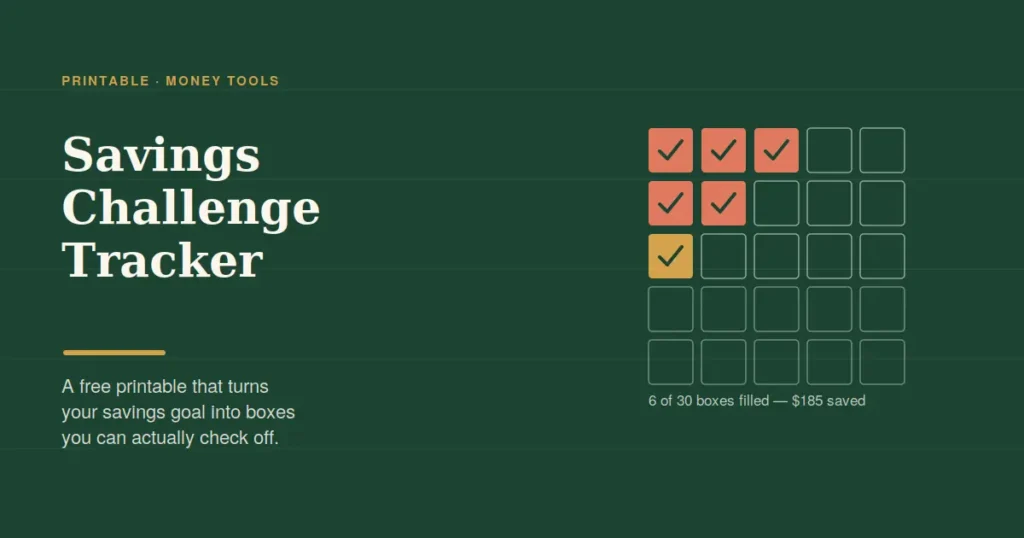
At its core, a savings challenge tracker printable is a one-page chart, usually broken into small increments, that you fill in as you save. Some are simple 52-week trackers where each box represents a dollar amount that increases slightly over time. Others are themed around a specific number, like a $1,000 challenge broken into 100 boxes of $10 each.
The beauty is in the flexibility. You can print one for a vacation fund, an emergency fund, a holiday gift budget, or just a general “get better with money” push. A lot of people assume these trackers only work for people who already have steady paychecks, but here’s what actually happens: irregular earners often benefit from them the most, because the tracker doesn’t care what week the money came in — it only cares that it eventually did.
Why the Visual Format Works Better Than an App
This is where I’ll push back a little on popular advice. Everyone loves to recommend budgeting apps, and plenty of them are genuinely useful. But an app buries your progress behind a login screen and a dashboard you have to actively open. A printed savings challenge tracker printable sits on your wall or in your planner, visible without you doing anything at all.
There’s a psychological reason this matters. Behavioral researchers have long noted that visible progress markers increase follow-through, because your brain registers a small win every time you fill in a box. That’s a real, physical dopamine hit that a notification on your phone just doesn’t replicate the same way.
How to Use a Savings Challenge Tracker Printable Effectively
Printing the tracker is the easy part. Sticking with it is where most people stumble. Here’s a simple process that works whether you’re saving $500 or $5,000.
- Pick a specific dollar goal and a realistic timeframe — 12 weeks, 26 weeks, or a full year.
- Choose a tracker style that matches your income pattern (fixed paycheck versus irregular income).
- Put the tracker somewhere you’ll actually see it daily, not buried in a drawer.
- Fill in a box the moment you transfer money, not at the end of the month.
- Adjust the order of boxes if a specific amount feels too big for a given week — nobody says you have to fill them in sequentially.
That last point matters more than people realize. Rigid savings challenges often collapse because someone hits a $75 week during a month when money is tight, and they quit entirely instead of just skipping to a $15 box first.
Making It Work With a Monthly Budget for Irregular Income
If your paycheck isn’t the same every month, a savings challenge tracker printable needs a slightly different approach than the standard 52-week grid. Building a monthly budget with irregular income starts with figuring out your lowest realistic earning month, then budgeting off that number instead of your average.
Once that baseline budget is in place, the savings challenge tracker printable becomes a flexible add-on rather than a rigid schedule. In a strong income month, you fill in three or four boxes at once. In a lean month, you fill in one, or none, and pick it back up later. The tracker doesn’t punish you for irregular income the way a fixed weekly savings plan does — it just keeps a running visual of where you stand.
A few practical tips for combining the two:
- Base your monthly budget with irregular income on your worst month in the past six to twelve months, not your best one.
- Treat any income above that baseline as “bonus” money that goes straight toward tracker boxes.
- Keep a small buffer categorized separately from your challenge savings, so a slow month doesn’t force you to break into progress you’ve already made.
If you’re also tackling debt at the same time, having a solid budget in place first makes the savings challenge tracker printable far easier to stick with, since you’re not fighting two goals with the same limited dollars.
Common Mistakes People Make With Savings Trackers
Even a well-designed savings challenge tracker printable can fall apart if a few habits sneak in.
- Choosing a goal amount that’s disconnected from actual take-home pay.
- Filling in boxes based on what you meant to save rather than what actually hit the account.
- Printing multiple trackers for multiple goals at once and losing focus on all of them.
- Giving up entirely after missing one week instead of just continuing from where they left off.
None of these mean you’re doing it wrong in some fundamental way — they’re just common friction points, and knowing about them ahead of time makes it easier to work around them.
This article is for informational purposes only and does not constitute financial, investment, or legal advice.
Read This
Envelope Method Savings Challenge: A Real Plan That Works
FAQS
Is a savings challenge tracker printable actually effective, or is it just a gimmick?
It’s effective for the same reason habit trackers and fitness charts are effective — visible progress reinforces the behavior. It’s not magic, but for people who respond well to visual cues, it genuinely helps close the gap between intention and action.
Can I use a savings challenge tracker printable if my income changes every month?
Yes. The trick is not filling in boxes on a strict weekly schedule. Instead, treat the tracker as flexible and fill in more boxes during strong-income months and fewer during lean ones, ideally alongside a monthly budget built around your lowest earning month.
Where should I keep my savings challenge tracker printable so I actually use it?
Somewhere you already look daily — a fridge, a planner, or next to your desk — works far better than a folder on your computer. The whole point is passive visibility, not another tab you have to remember to open.